So what is the real purpose of algebra? I am no mathematician, but I believe it is, essentially, the art of discovering the unknown; the science of making correct calculations when you have practically no data. It is mysterious and beautiful. I respect the learned scholars who created and developed it. The purpose of this campaign, I repeat, is NOT to undermine the significance of algebra as a branch of knowledge, but rather to question its place in the school curriculum.
 The thing is, no form of knowledge is ever entirely useless. But if we are to teach something to an entire nation, an entire generation, we have to be sure that it will be worth their time. By choosing to teach one subject we forgo countless others. What we must realise is that nothing is set in stone and we should be willing to question our present if we want a better future. I would like to remind everyone that in the not-too-distant past (up until the mid 20th century) Latin was being taught as a compulsory subject in schools, although it was already a dead language. Like algebra, it had a firm place in the curriculum those days and was strongly believed to be necessary by the majority. Someone (thankfully) finally realised that it was a waste of time and brainpower and it was eventually removed.
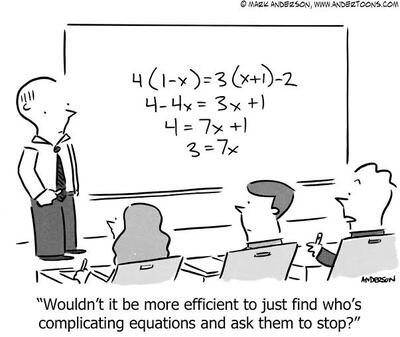
That's the kind of approach we need with algebra. Not the stick-in-the-mud that's-how-it's-always-been-and-will-be viewpoint; not some pointless justification for it just because it's been around for so long, but a sincere review over whether it's really what the students need the most, more than countless other subjects and branches of knowledge that could be taught instead?
Unfortunately, few have the courage to question established norms. Just look at how long it took people to eliminate a dead language from the school syllabus! Fortunately, there are some who do go against the grain for the greater good. I can't go on without mentioning the champion of the modern anti-algebra sentiment: Professor Andrew Hacker, author of The Math Myth, whose famous (or infamous!) New York Times op-ed piece, Is Algebra Necessary? triggered countless heated discussions and responses. His main points were that most students fail algebra year after year (he had the data to back him up), and the reason for that is because it has no relevance in their daily lives. Rather than continuing to torment them with this painful and much-hated subject, he argued that a better solution to this educational failure was to replace algebra with more useful maths which is applicable for everyone, like arithmetic and finance, etc.
Of course, a number of articles were published in a fierce response to him, stating that algebra was, in fact, necessary. All of them seemed, to me, to have the same two arguments:
1. Describing the failure rate of a subject does not mean we should eliminate it, but that we should improve the way it is taught
2. If you say we should eliminate algebra just because it is not important in our 'daily life', then neither is literature or history or countless other things we learn at school which everyone is okay with
I'd like to specially address these two before I go on. The thing is, if such a huge number of students is failing a subject repeatedly, then while it could, of course, be because it is not being taught well, there could also surely be a greater reason. Rather then imposing further classes and remedial maths and whatnot, wouldn't it be better to see why they are failing? Why they dislike this subject so much? Ask anyone, and they will tell you the same thing; they have no use for it whatsoever. It has zero relevance to them. Humans are intelligent beings; you cannot force them to do something unless they see some point to it. Why can't these educationists and maths enthusiasts entertain this thought for even a second? And I ask them, rather than write those long, impassioned essays on how teachers, textbook writers, etc should better explain the beauty and unquestionable importance of algebra to their students and give them examples and so on, why don't they ever give us, the common reader, a list of ways we can all use algebra in our daily life? If I were to say that arithmetic is useless, you could easily explain without a moment's thinking, how essential it is in our daily lives, with enough everyday examples to change my view. That's how we convince little kids to study maths. And that's why they succeed. Why can't these experts do the same with algebra?
Then comes the second point, which is even more objectionable. It actually states that nothing taught in school is important in daily life! For one thing, if this is somehow proven true, then I think we need to remove more than just algebra from schools; we need to replace the whole syllabus! It all comes down to whether you think what is taught in school should be truly important for every citizen to know or not. Whether the knowledge we learn there should help us everyday for the rest of our lives. Surely we agree on that!
 Now, someone arguing that 'as literature isn't important in "daily life" but we learn it anyway, so algebra should be unquestionably studied as well' makes two major mistakes: for one thing, they are massively disrespecting the arts. How are we supposed to respect algebra if so many of its advocates choose to defend it by insulting another subject? This retort also strategically diverts one's attention elsewhere; rather than looking into the usefulness of algebra, we end up straying from the main question and debating instead whether Shakespeare should be taught or not. These remarks make casual assumptions (=literature is useless/history is useless) which are left uncleared and are downright offensive.
Such discussions are lengthy, tiresome, and unnecessary. Do we really have to go into the usefulness of every other school subject before we dare continue the debate on algebra? I don't think so.
But in short, I think I can safely say that any highschooler can easily list the daily-life uses, applications, and relevance of all other school subjects. The exact content and/or teaching methods could always have room for improvement, perhaps, but the importance of the subject itself is definitely clear to all. With algebra, however, it all turns murky. In my opinion, we need a lot more solid answers before we can dismiss Hacker's original question forevermore.
As important as Hacker is, he is neither the first nor the only one to raise the question against algebra; Christopher Edley, the Dean of UC Berkeley, argued famously that algebra is the main setback for many brilliant students who could have otherwise had lucrative careers; he also notably stated:
a dirty secret about math requirements: the requirements are largely arbitrary. They often reflect tradition or a data-free faculty intuition about the academic grounding students need...
For the head of a well-respected institution to say something controversial like this is no doubt, shocking, but he supported his every statement with data and statistics to prove his point.
Hacker and Edley are not the only highly educated people to object to algebra; Ph.D. holder Temple Grandin wrote in The Atlantic,
The more students fail math, the more math we throw at them, and the more we test them. That has been the illogic of the past two decades.
 Going even further back, we must remember William Heard Kilpatrick, a controversial and revolutionary educationist from the 20th century who was strongly against algebra as a school subject and made great efforts to eliminate it. As he gained influence, he nearly succeeded. He stated in one of his lectures that
We have in the past taught algebra and geometry to too many, not too few.
That's not all. In 1930, a former commissioner of education in Massachusetts stated:
the algebra now taught in American high schools is a nonfunctional and therefore a nearly valueless subject for 90 per cent of all boys and 99 per cent of all girls.
Why then, after all the strong arguments that have been made against algebra by such reputatable people throughout these last hundred years, do we insist on dragging it on, generation after generation, essentially bogging our youth down and limiting their potential to shine? Why make something unnecessary necessary? Why defend something that harms us more than heals us?
You've suffered your way through algebra; you don't have to let your children do so too. Just like the removal of Latin as a compulsory subject changed your childhood for the better (although, if you wanted, you could have chosen it as an optional course), likewise, the removal of algebra can improve the lives of our generations ahead, and enable them to complete their studies and pursue their dream careers with ease and enjoyment.
If you, too, feel that something is wrong with the way things are, then you also must campaign against it in whatever way you can. Share, tweet, write, or even protest if that's your vibe; but do something. The future is ours.
- December 2025